Filipinos report some healthy habits and consider supplements a need, while local governments could do much more to provide basic health services.
Key Takeaways
- Filipinos seem to be reporting some level of healthy behaviors, and they express it in terms of eating certain food groups, doing some physical activity, and getting what they perceive is enough sleep.
- Most Filipinos are aware of the new advisory on supplements, and a significant proportion continue to patronize them and consider them as a need.
- Filipinos perceive in general that their local governments are not doing enough in providing basic health services.
The Demographic and Health Survey (DHS) is a treasure trove of health data utilized by almost 100 countries. The Philippines had its seventh round in 2017, and it is the largest health survey to date. Around 27,000 households participated, double from the last round in 2013. A full report and open-source access to the data sets are always provided as each round is concluded (access the 2017 files here, by making a free account, then sending a request to access the data; approval happens within 48 hours).
Because of this, researchers like me are able to conduct our own secondary analyses. As hundreds of variables are included in the DHS survey questionnaire, not all will make it to the full report.
This post (rather, three smaller posts) is the first in a series of supplemental analyses I am doing on the 2017 DHS. Note that most of these analyses are descriptive in nature, for reasons I will discuss below and in future posts. I use Stata 15 to clean and analyze the data, and all files are available upon request.
What do Filipinos do to keep healthy?
The 2013 and 2017 DHS asked a question about what survey participants do to keep themselves healthy. They responded freely and their answers were recorded across multiple categories. The top 5 responses are shown below:
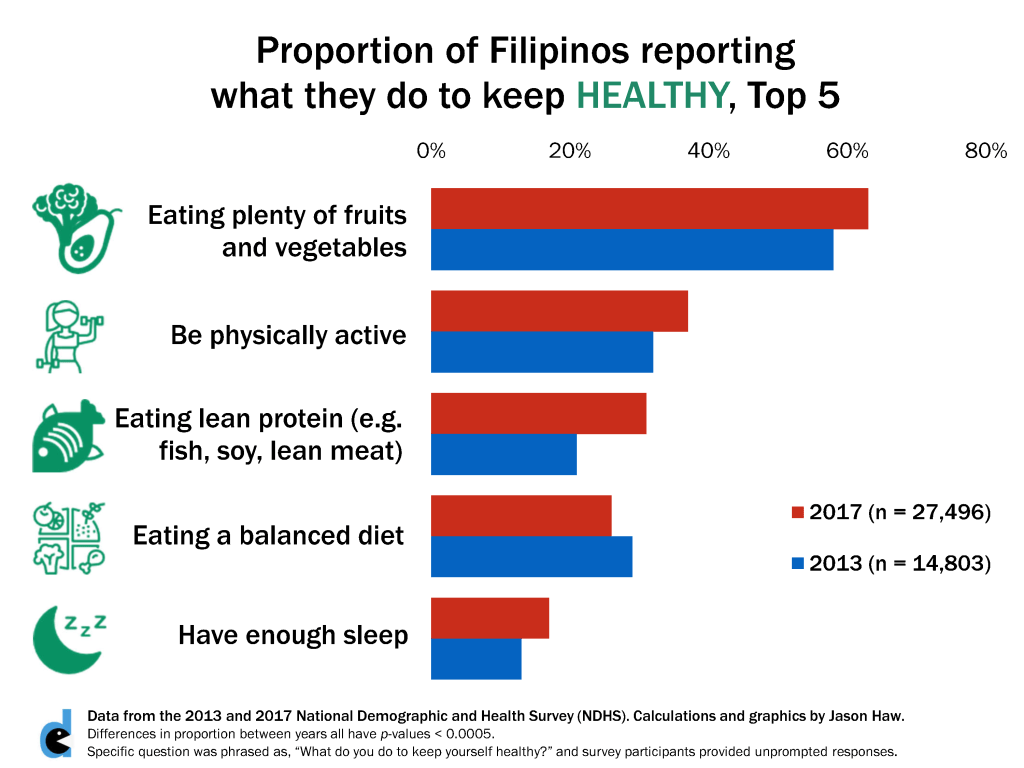
The results are hardly surprising. When unprompted, Filipinos say they keep healthy by eating right, being physically active and sleep enough hours. No significant differences were noted between males and females. Higher education and higher wealth were correlated with higher proportions of reported healthy behavior.
Two interesting things are of note. First, much fewer respondents mentioned what they avoid, such as smoking (8% in 2017). In contrast, the latest Global Adult Tobacco Survey (GATS) reports that only a quarter of Filipinos were current smokers in 2015. Assuming the data are directly comparable (at least on a national-level perspective), there were two-thirds of Filipinos who were not able to actively mention what they do about smoking.
Second, the way the categories were formulated are in no way a comprehensive assessment of a healthy lifestyle. The mere mention that certain food groups were consumed are not an indication of a healthy lifestyle – any nutritionist-dietitian will tell you that all food and drink must be taken in moderation. There were also vaguely defined responses such as “maintain happy personality” or “maintain good hygiene.”
I would caution against any further analysis of the responses. Measurement through self-reporting in a quantitative survey is one of the worst ways to collect data on health behaviors. First, people lie – who would want to admit that they are not doing at least one thing to keep themselves healthy? Second, restricting responses to certain categories, no matter how many, prevent the depth necessary to understand the complexity of health behavior. In many social and behavioral research studies, qualitative or mixed method (quantitative and qualitative) approaches are more appropriate.
Perhaps the data may be more appropriate in presenting perceptions of Filipinos on what a healthy lifestyle is, not necessarily what their actual behaviors are.
How much do Filipinos patronize supplements?
The Food and Drug Administration (FDA) ordered the replacement of the old “No Approved Therapeutic Claim” label for dietary supplements and other related products with the advisory, “Mahalagang Paalala: Ang (name of product) ay hindi gamot at hindi dapat gamiting panggamot sa anumang uri ng sakit” in 2014, after a long court battle with the Chamber of Herbal Industries of the Philippines.
The change was intended to better educate Filipinos when purchasing these products. The 2017 DHS had a series of questions related to this advisory, summarized in the following infographic:
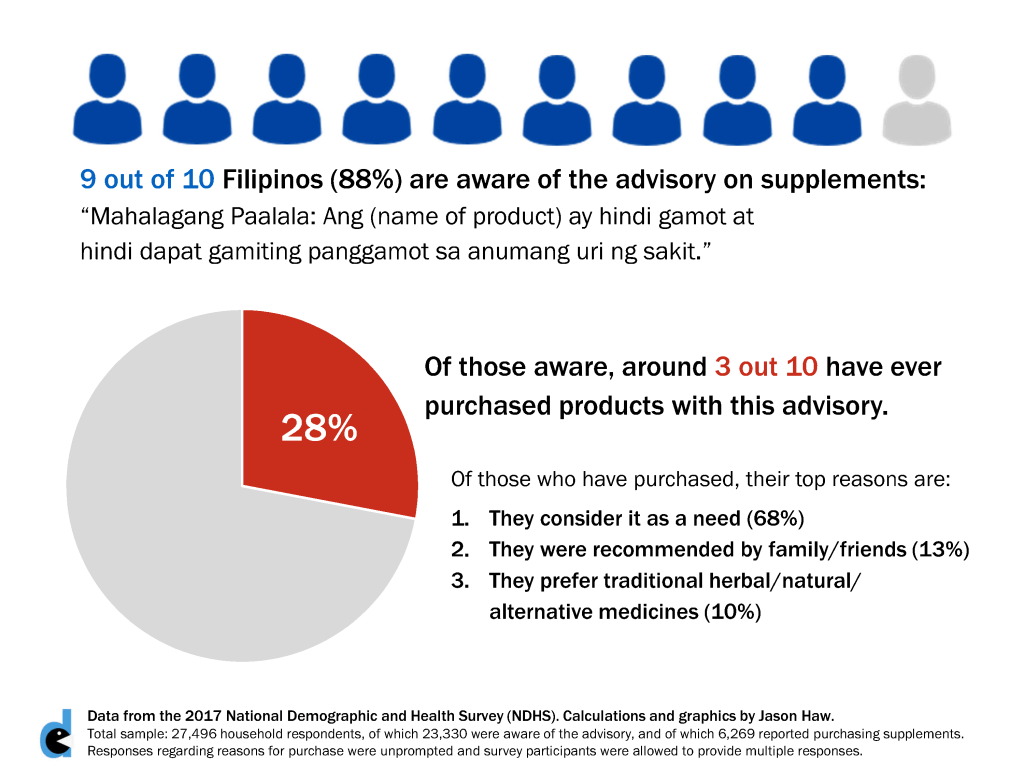
A good majority of Filipinos were aware of the advisory. Of these, around a third have purchased products with this advisory. Of these, around two-thirds claim that they have purchased these products as a need.
Recall of the advisory seems to be good, and FDA may be concerned with that majority of consumers who said that they considered supplements as a need. However, there were no other follow-up questions that provide more context. What is a “need,” exactly, in this sense? Is it a need in the same way that medicines are a need to treat certain diseases? Is it a need because it complements the benefits of medicines? The categories could have been phrased more clearly.
The definition of supplements may also differ across respondents. The Food and Drug Administration defines a “Food/Dietary Supplement” as “a processed food product intended to supplement the diet that bears or contains one or more of the following dietary ingredients: vitamin, mineral, herb, or other botanical, amino acid, and dietary substance to increase the total daily intake in amounts conforming to the latest Philippine recommended energy and nutrient intakes or internationally agreed minimum daily requirements. It usually is in the form of capsules, tablets, liquids, gels, powders or pills and not represented for use as a conventional food or as the sole item of a meal or diet or replacement of drugs and medicines.” (Note: I cannot find a public copy of the FDA Administrative Order 2010-008 but I have an internal copy available upon request).
Dietary supplements with outlandish claims, such as fruit-based products that claim to “cure” cancer, definitely deserve the FDA warning. But what about iron and folic acid supplements, which are actually essential public health interventions for pregnant women? Moreover, a quick search of available television commercials of these supplements on YouTube seem to imply that there are a number of companies violating the FDA regulation.
What is the point of the questions, exactly? If the intention was to determine the impact of the revised advisory on consumer choices regarding their health, then these questions do not provide enough insight. If the intention was to determine if recall of the advisory is good, then the question about awareness was good.
What do Filipinos appreciate from their local governments when it comes to providing health services?
Health service delivery is devolved to local governments, thus experiences may range from wealthy city governments being able to heavily subsidize health care through specific colored cards to rural municipalities struggling to retain basic health care staff. The 2017 DHS had a series of questions asking survey participants what health services they know are being initiated by their local government, and whether they have ever utilized any of those services. The responses regarding awareness were unprompted, then probing questions were asked to determine utilization. Top 5 services are shown below:

Only four-fifths (82%) of participants reported any health initiative by their local government. Only two programs were known by more than half of the participants – free medicines and free medical consultation. The results seem to show a gap in the actual service delivery, awareness about it, or both.
Also, many of the programs that the participants mentioned are more likely to have been provided by national government rather than local government. For one, most vaccines are procured by the Department of Health (DOH) and provided for free under the
Mandatory Infants and Children Health Immunization Act of 2011. Medicines for prevalent diseases such as tuberculosis are also provided for free by DOH. Some of the public doctors providing free medical consultation may have had their salaries paid by DOH through the Doctors to the Barrios Program and not as retained staff of the local government. There are many complexities to the Philippine health system that the questions failed to capture.
Some caveats
- Not all questions can be answered through a quantitative survey. While the huge sample size is helpful to have a clearer national view of the health situation, it doesn’t seem to do anything to mitigate accuracy issues.
- Questions may need to be revisited for future rounds of the NDHS as they seem to be vague and muddle possible insights one can gather from the data.
I hope we always take a nuanced look at whatever pieces of data are being presented before us, especially with indicators that directly affect human lives.
The icons I used in the figures are from flaticons.com. I would like to credit the following artists – Smashicons, Good Ware, Becris, dDara, Freepik, and mavadee – for allowing me to freely use their work.
All of my figures in this post and the rest of blog may be freely shared under Creative Commons 3.0 Attribution-Non Commercial-Share Alike.
 Jason Haw, PhD