The past two years have been a glorious fight for equal marriage rights but it’s far from over.
The Legislative Yuan, Taiwan’s parliament, overwhelmingly voted (66-27) the “Enforcement Act of Judicial Yuan Interpretation No. 748,” an unassuming name for the unprecedented law in Asia legalizing same sex marriage. (See the infographic from Reuters below on the status of same sex marriage worldwide)
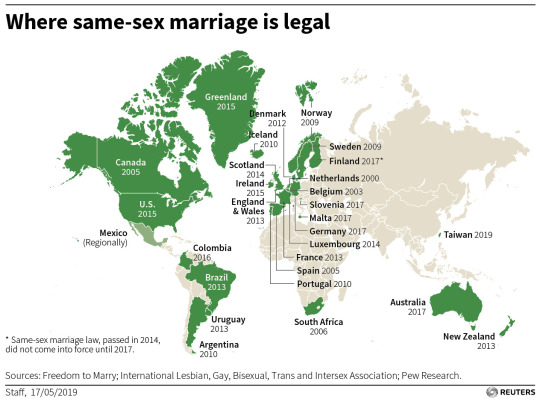
While the law is clear about the recognition of same sex marriages as marriages, not all civil rights are guaranteed for Taiwanese same sex married couples. I have been following this story very closely for the past two years, and this post summarizes what has happened over that period, why the law was crafted that way, and what it means moving forward.
What is Judicial Yuan Interpretation No. 748?
The Constitutional Court, the highest body in the Judicial Yuan, issued their ruling on May 24, 2017, effectively guaranteeing the possibility that same sex marriage will be legalized in Taiwan. The Constitutional Court gave the Legislative Yuan a two-year deadline to pass a law legalizing same sex marriage, otherwise same sex marriage will be legal by default through its decision regarding the Civil Code.
At the center of this Court Case is LGBT activist Chi Chia-Wei. Chi has been fighting for LGBT rights in Taiwan since 1986, so this court case decision was 31 years in the making. He had unsuccessfully tried to apply for a marriage license multiple times with his same sex partner, until his last attempt in 2013. During this attempt, he appealed for his case higher and higher in Taipei’s municipal bureaucracy, until in 2015 when the municipal government sought a constitutional clarification on the matter.
The decision of the Constitutional Court was that the current Civil Code is in violation of the Constitution, specifically the following articles:
- Article 22: “All other freedoms and rights of the people that are not detrimental to social order or public welfare shall be guaranteed under the Constitution.” – one of the rights guaranteed under this article is the right to marry
- Article 7: “All citizens of the Republic of China, irrespective of sex, religion, race, class, or party affiliation, shall be equal before the law.” – this guarantees that sexual orientation should not be a basis for refusal of the right to marry
Therefore, same sex marriage is guaranteed under the Constitution, but the current Civil Code definition that marriage should only exist between a man and a woman violates the Constitution. Therefore, some policy change must be enacted to correct for this error.
Some might argue that the Court is overstepping its role by interfering in the legislative functions of the Legislative Yuan. But there have been precedents of judicial lawmaking in the past.
The political climate was also favorable for legalization, as one of current President Tsai Ing-Wen’s campaign promises during the 2016 Presidential campaign was to legalize same sex marriage.
On May 17th, 2019 in #Taiwan, #LoveWon. We took a big step towards true equality, and made Taiwan a better country. 🏳️🌈
— 蔡英文 Tsai Ing-wen (@iingwen)
The past two years have been critical moments for both supporters and opponents of same sex marriage, the most important being the 2018 referendum on same sex marriage. This is why a law was only passed by the Legislative Yuan at the last minute, one week before the scheduled deadline of May 24, 2019.
Why was there a referendum, and what was it exactly about?
President Tsai’s party, the Democratic Progressive Party (DPP), could easily have passed a same sex marriage law right after the Court decision. After all, they hold a significant majority in the Legislative Yuan, thereby not needing the support of the main opposition, the Kuomintang Party (KMT), known to be more conservative.
However, President Tsai and the DPP’s approval ratings have dropped significantly since she started taking office. This is largely due to the stagnating economy, which heavily relies on the People’s Republic of China (PRC). The PRC does not like having the DPP in power as the DPP is historically known for their assertion of Taiwanese independence and have openly refused the 1992 Consensus. The 1992 Consensus is a political declaration by PRC and Taiwan (or officially, the Republic of China) that states that both PRC and ROC agree there is only one China, which is both mainland China and Taiwan, but disagree as to what that exactly means in terms of sovereignty.
Therefore, the DPP was slowly waning in its active support for one of their more controversial party platforms. Instead, the DPP seems to wait the clock out until same sex marriage becomes legal by default. But this also gave time for opponents of same sex marriage to campaign against it as much as they legally can.
The key way that they were able to undermine the Court decision was through a referendum. On December 2017, key amendments to the Referendum Act were enacted, which lowered thresholds to put a motion up for referendum, as well as the proportion of votes required for a referendum to pass. The amendments were largely seen to make the electoral process more democratic, and as a result, ten referendum questions were included in the November 2018 local elections (Referendum 12), three of which were related to same sex marriage. The questions were as follows:
- “Do you agree that marriage defined in the Civil Code should be restricted to the union between one man and one woman?” (Proposition 10) – When passed, this increases the pressure on the Legislative Yuan to pass a separate law, rather than make amendments to the Civil Code or waiting out the two-year Court-imposed deadline;
- “Do you agree to the protection of same-sex marital rights with marriage as defined in the Civil Code?” (Proposition 14) – Similar to Proposition 10, this further clarifies that when rejected, amendments to the Civil Code become more unlikely; and
- “Do you agree that the Ministry of Education should not implement the Enforcement Rules of the Gender Equality Education Act in elementary and middle schools?” (Proposition 11) – When passed, this decreases the likelihood that LGBT-related education will be taught as part of the Taiwanese basic education curriculum.
While referendums are non-binding, a resounding majority vote is a strong indication of public opinion and can threaten the ruling party’s political standing in the next election if it refuses to respect the results. All three motions won in favor of same sex marriage opposition groups, 2-to-1. In an added blow to the DPP, they lost most of their local races, leading to President Tsai’s stepping down as party chair and jeopardizing her and her party’s political future in the 2020 elections.
After the referendum, the challenge then was to create a law that both complied with the Court decision AND respected the referendum results. This meant that while same sex marriage will still probably be legalized, some concessions need to be made to make that happen.
What ended up being the law?
For the first few months of 2019, three legislative proposals were put forward by opposing groups:
- The opposition-backed bill, “The Enforcement Act of Referendum 12” was the most watered-down version. Same sex couples were referred to as “same sex familial relationships,” which makes the legal language terribly confusing as it can be interpreted as typical, non-sexual same sex family relationships like mother and daughter. The minimum age requirement for marriage was also raised to 20 as compared to the Civil Code minimum age of 18.
- A bill drafted by a more conservative DPP member, “The Enforcement Act of Judicial Yuan Interpretation No. 748 and Referendum 12,” kept the minimum age requirement of 20 but calls same sex marriage as a civil union and called same sex couples as domestic partners. However, it had a highly controversial provision where a relative up to the third degree of consanguinity can file for an annulment even without the same sex couple’s consent. The rationale behind this was that sham marriages were going to be common among same sex couples to gain the benefits of civil union, and this rationale definitely does not make any sense. Furthermore, it protects the religious and cultural freedoms of those who may be opposed to the idea of same sex marriage.
- Finally, there was the government-crafted bill, “The Enforcement Act of Judicial Yuan Interpretation No. 748” which was the most progressive among the three. Same sex marriages will be called marriages, and same sex couples will be called spouses. It also affords the most civil rights and lowers the minimum age threshold to 18, similar to the Civil Code.
The first two bills were not even put to a vote anymore as the third one won by an overwhelming majority. However, the two most controversial provisions that passed are as follows:
- With regards to adoption, only the biological children of one spouse can be adopted by the other. Same sex couples cannot adopt other children.
- With regards to marriages with a foreigner, the marriage will not be recognized if the foreigner is a citizen of a country where same sex marriage is not yet legal. This means that a Taiwanese and an American couple can get married, while a Taiwanese and a Filipino cannot.
With regards to the second controversial position, this is in accordance with a Taiwanese law (An Act Governing the Choice of Law in Civil Matters Involving Foreign Elements) that states that the marriage of a couple of different nationalities must follow the rules of both spouses’ countries. Advocates were hoping that an exemption would be granted under a same sex marriage legalization law but said amendment was overwhelmingly rejected.
So what does this mean?
Same sex marriage is legal, but the fight for equal rights is far from over. Advocates accepted the government-backed bill as the lowest possible compromise and promise to fight for the remaining rights down the line. Opposition groups are also ramping up efforts to undermine the law’s credibility and rally public support in their favor.
The key lesson here is this: change takes time, and when it comes, it may not be perfect. But that’s okay – we have tomorrow to fight and make it perfect.
 Jason Haw, PhD